
Historical Japanese Architecture

Mas Imazumi Gate was built by Hiroshi Sakaguchi of Occidental, CA in 1999. The structure is made of Port Orford cedar and redwood. It’s located at Bonsai Garden at Lake Merritt, CA and is open year round to the public.

Machiya is a style of building which houses both a commercial enterprise in the front and residence at the rear.
Kyo no Machiya was originally built in the Nishijin district of Kyoto, Japan in 1830 and was occupied by a traditional silk merchant. In 1980 it was transported and reconstructed by Japanese carpenters at the Boston Children’s Museum.
As a permanent exhibit of the museum it offers an opportunity to experience a traditional Japanese building maintained in excellent condition, showing not only the structure but also furnishings such as shoji, tatami, fusuma, and additional artifacts.
The museum is open year round. For more information visit https://japanesehouse.bostonchildrensmuseum.org/
View or download a PDF of an Asia magazine article titled, “A Japanese Roof Raising in Boston” here.

Hakone Chu Mon (central gate), is a Shoin Style Gate, built in 1937 by traditionally trained Japanese craftsmen. The structure is based on proportions and design scale developed in the earliest Chinese history, and further refined in Japan during the Edo Period (1602-1860). The unusual use of California Coastal Redwood for the entire structure, points to the Nishiura brothers’ desire to create a large authentic Japanese style gate structure using native woods of California. The main elements include ornate carved gable-ends topping the shingle roof, and wide wooden gate-panels highlighting the old-growth redwood. The twelve-foot wide gate also has a central support post, and heavy timber frame. The Hakone Gate has been listed on the National Register of Historic structures since 1984.
You can view or download a PDF that goes into detail on the Hakone Decorative Carving on the central gate here.
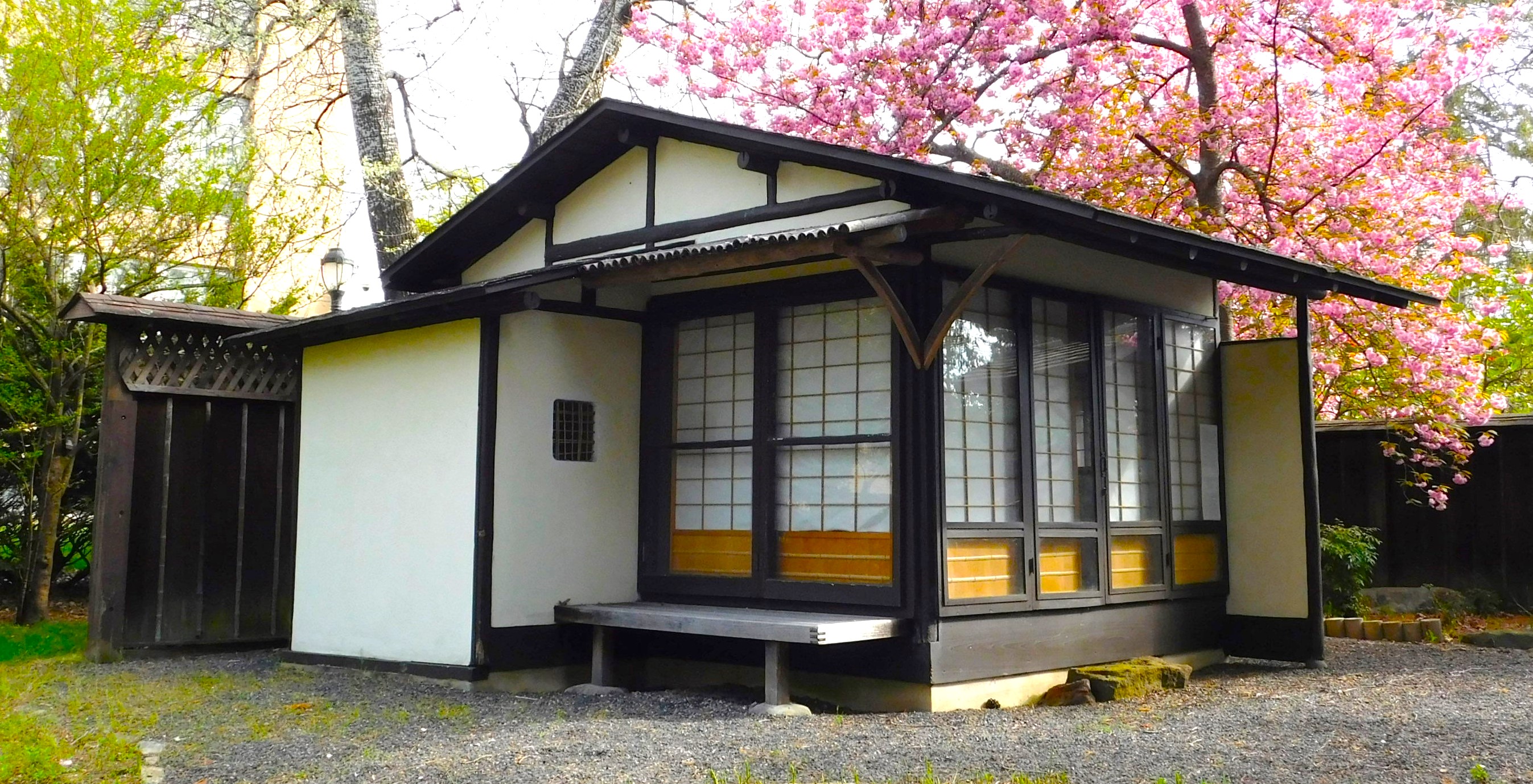
The tea house in the Japanese Garden at Georgian Court University is believed to have been built for the 1910 Japan-British Exhibition in London. Believed to have been designed by architect Hayami-ryu iemoto Soen Sokyu (Niwa no Sokyu, 1840-1924), it may be the earliest authentic tea house in the United States. Based on design and construction details, it was probably constructed in Japan by traditional sukiya-daiku, carpenters specializing in tea house style construction, using only hand tools. Major timbers are likely to be Japanese cedar (sugi, Cryptomeria japonica).
Following the exhibition, it was installed in the Japanese garden designed by Takeo Shiota at the George Gould Estate known as Georgian Court in Lakewood, NJ.
The tea garden includes an outer garden with a winding path that transports visitors over a dry stream bed via a wooden bridge. Upon entering the inner garden via a gate, visitors find a 1910-era machiai and a tsukubai, two more wooden bridges and a stone bridge passing over dry streams, numerous stone lanterns, and a waterfall, with numerous large rocks and hilly topography evoking Japan. The vegetation includes native and exotic conifers, Korean rhododendron, azaleas, camellias, and many cultivars of Japanese maples. The tea garden is part of the more than 100 acres that comprise the Georgian Court University campus, which is a National Historic Landmark.
Between 2014 and 2024, the garden’s wooden bridges and gate were rebuilt and extensive renovations were made to the tea house. This work was done by Peter Wechsler of Daiku Woodworking (Boonsboro, Maryland).
The garden and tea house are open to the public year round at 900 Lakewood Ave., Lakewood, NJ 08701.
Today the teahouse is used for tea ceremonies and other events open to the public.
For more info visit: https://www.georgian.edu/arboretum.